Paddington station stands to this day as a testament to the amazing talent of the prolific Victorian era engineer Isambard Kingdom Brunel. The role of Victorian engineering in driving forward advances made by the industrial revolution is strikingly clear when we consider the history of this iconic English train station. A five minute walk from Hyde Park and Lancaster Gate it serves as a main travel hub for reaching the West country and London’s busiest airport, London’s Heathrow. However, its role in the movement of ordinary people and one beloved South American Bear at pivotal moments in history is of equal significance and has ensured its place in hearts.
Paddington Station – A place in History
Construction of the Brunel designed station began in 1850, with the original four platforms, completed at height of Victorian engineering innovation in 1854. This being a time when steam powered engines were about to change the face of life on earth forever. The sheer volume of traffic needed to service the wheels of industry would have been impossible without steam. Not only was it necessary for movement of workers to service the new industries but importantly food and other essentials for the expanded city population. Paddington Station was an answer to the streamlining of these necessary services. As an example, in 1881 a “milk dock” was built and at its height over 3000 milk churns moved through the station everyday. The massive wrought iron arches that have long held the glass roof in place over the station have also carry a large load in history.
Paddington Station – A place in Hearts
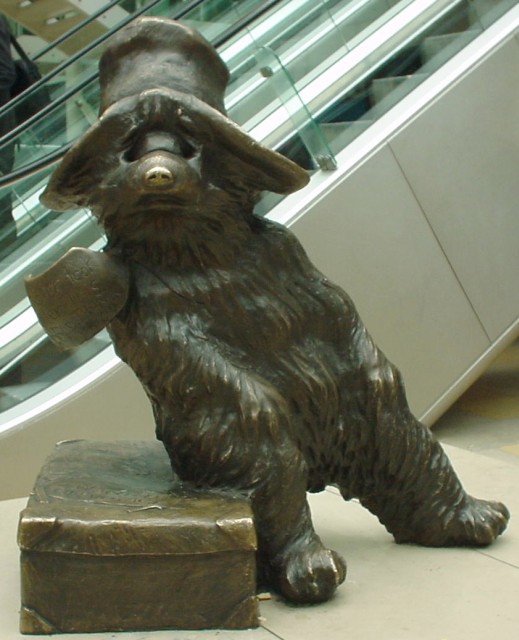
With the original four platforms expanded to 12 by World War ll, Paddington Station’s wide and encompassing arches were embracing people on the move for reasons never conceived by the talented Mr Brunel. Troop movement during both world wars was not the only mass movement that Paddington Station saw. It was from Paddington’s busy platforms that the smallest casualties of World War II traveled to the safety of the west coast of England and Wales. During the Blitz of London, as bombs were raining down on the city, it was deemed necessary for the children of London to be evacuated to the country. It was the images of the children, standing scared and forlorn on the platform, suitcase in hand and name tag hung around their necks that inspired the creation of Paddington Bear by Michal Bond in 1958 [read more]. These memories of a world at war ensure Paddington Stations place in the hearts of all those who visit.
Paddington Station has earned its place in time.
Paddington Station is a perfect place sit, look and reflect on all that London in particular but also the world at large has experience in the last nearly two hundred since Brunel first conceived his design for this iconic station. Situated in central London, Paddington is easily accessible to all visitors. It truly is a destination that has earned its place in time and well worth a visit.
Time for tea, or adventures nearby in a Paddington bear wandering style
If you are going to be stopping at Paddington Station then a short walk from the station you can find lots of local treats to mark your journey with something different. Afternoon tea, one of Paddington bear’s favourite pastime can be enjoyed at a number of hotels near the station such as Royal Lancaster London. If you want to stretch your legs then Paddington station is a 10 minute walk from one of London’s most beautiful parks, Hyde Park, and there’s a children’s playground right near the Italian Gardens (that’s where you would arrive most naturally walking from Paddington Station). If you’re looking for something more historic (and what could be more historic than Paddington Station itself!) then Kensington Palace can be reached from Paddington in about 15 minutes on foot (it’s a nice walk too!).

 From London to Bangkok
One thought on “Paddington Station, a special place in history and hearts”